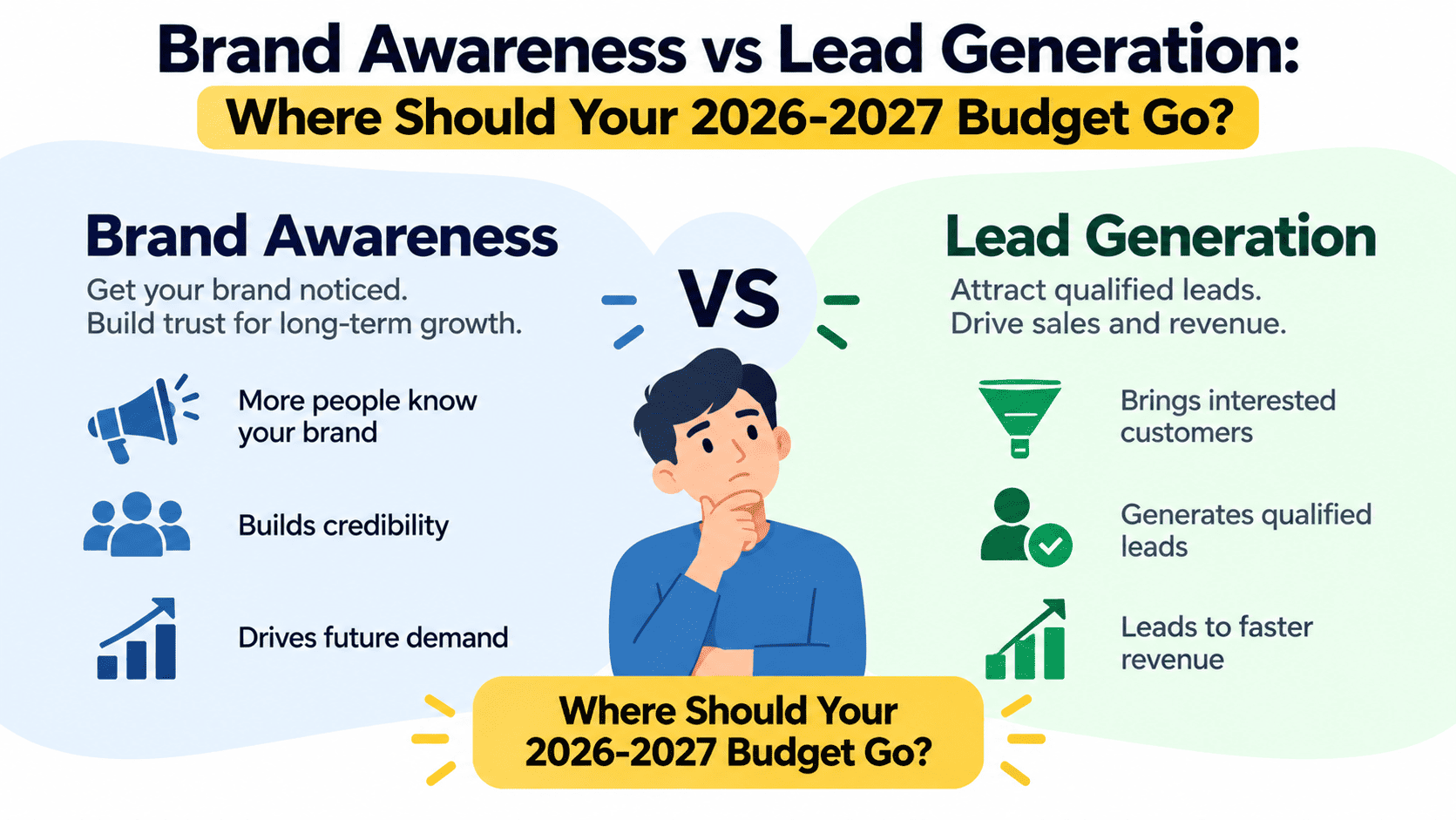
Brand Awareness vs Lead Generation: Where Should Your 2026-2027 Budget Go?
Your cost per lead went up again this quarter. So the team wants to cut “fluffy” brand spend and push harder on ads. Sound familiar?
It’s one of the most expensive calls a business can make, and most teams make it without checking whether it’s the right one. The brand awareness vs lead generation debate isn’t solved by a ratio from a blog post. It’s solved by what your own data says you’re short on.
Here’s how to find out.
The Short Answer
If your cost per lead keeps rising while your conversion rate holds steady, you probably have an awareness problem. If traffic is healthy but enquiries are low, you have a conversion problem. Moving budget around without knowing which one you have is just rearranging the same issue.
What’s the Difference?
Brand awareness is about being known and trusted before anyone is ready to buy. You’re building familiarity, so when a need finally pops up, your name is one of the first that comes to mind.
Lead generation is about capturing people who are already showing interest: enquiry forms, gated guides, webinars and search ads aimed at active buyers. Awareness creates demand at the top of the marketing funnel. Lead generation captures it lower down.
Here’s the part many teams miss. A strong brand usually makes lead generation cheaper over time, because people who already recognise you tend to trust you faster and need less convincing.
The Idea: Awareness Debt
Every business has a gap between the people who would buy from you and the people who’ve actually heard of you. Let’s call that gap awareness debt.
Lead generation spend pays interest on that debt. If few people know you, every ad and campaign has to introduce you from scratch. You keep paying to meet the same strangers, and each lead tends to cost more. Brand work pays the debt down. Slowly, but it does.
Four Signals to Check in Your Own Data
1. Branded search trend. In Google Search Console, look at searches that include your business name. Flat or falling while ad spend rises? Few people are remembering you.
2. Cost per lead vs conversion rate. Compare both over six to twelve months. Rising cost with a steady conversion rate usually means your site isn’t broken. Your audience is just getting colder or more saturated.
3. Where your leads really come from. Count leads from direct visits, branded search and referrals versus cold paid clicks. If nearly every lead needs an ad to find you, you’re renting your demand.
4. What prospects say. Add “How did you hear about us?” to your forms and listen to first sales calls. “Who are you?” points to awareness. “How much?” points closer to a conversion or offer issue.
A note on measurement: no single signal measures awareness. Branded searches in Search Console are useful, but they only capture people who already remember you enough to type your name. Read them alongside direct traffic, referrals, survey answers and brand mentions, and remember that seasonality, campaigns and PR can move any of them.
How to Read What You Find
- Cost per lead rising, conversion steady, branded search flat: shift some budget towards awareness.
- Traffic healthy, conversion low: fix your website, offer and forms first. More spend anywhere won’t help.
- Plenty of leads, poor close rate: a targeting or qualification issue, not a budget split issue.
When to Invest in Brand Awareness
Lean towards awareness when you’re:
- Launching something new (nobody searches for a business they’ve never heard of)
- Entering a new market or region
- Rebranding or repositioning
- Hearing “Who are you?” on sales calls
- Facing a downturn, where going quiet can cost market share you’ll struggle to win back
Awareness takes patience. Results build over months, not weeks.
When to Invest in Lead Generation
Lean towards lead generation when:
- Your pipeline is thin and revenue targets are close
- People already know your brand and you need to convert that familiarity
- Your sales cycle is short
- Customer lifetime value comfortably beats acquisition cost
Lead generation is easier to measure and faster to show results. But it only harvests demand that already exists. If that pool is small, you’ll hit a ceiling.
How to Split Your Marketing Budget
There’s no perfect ratio, but some research gives a useful starting point. Les Binet and Peter Field’s well-known work on marketing effectiveness suggests roughly 60% brand-building and 40% activation for many consumer brands. For B2B, work done with LinkedIn’s B2B Institute points to a more even split, closer to 46:54 (WARC summary). Some researchers, including Byron Sharp of the Ehrenberg-Bass Institute, have questioned how universal these ratios are. Treat them as reference points, not rules, and let your own signals above overrule them.
A practical way to adjust:
- Established brands: Consider a 60:40 split between brand awareness and lead generation as a starting point, adjusting based on market conditions and performance data.
- Early-stage businesses: Prioritise lead generation when immediate revenue is essential, while maintaining an awareness budget to support long-term growth.
- New product launches: Consider a balanced budget split when both brand awareness and immediate customer acquisition are important.
Longer, complex sales cycles and lesser-known brands usually justify more brand investment. And be wary of cutting brand spend the moment leads dip. It’s tempting, and it’s a classic mistake.
Test Before You Commit: The 90-Day Split
Pick one region or audience segment. Move a modest share of its budget, say 10 to 20%, into awareness work like content, video, partnerships or social. Keep a similar segment unchanged as your comparison.
After 90 days, compare branded search, direct traffic and cost per lead between the two. If your sales cycle is long, give it longer. It’s not a perfect experiment, and small audiences make results noisy, but it beats guessing.
Why Awareness Matters More in 2026-2027
More people now ask AI assistants and AI search features for recommendations instead of scrolling through ten blue links. How visibility works inside those tools is still poorly understood, and measurement is limited.
The best public evidence so far is correlational. An Ahrefs study of 75,000 brands found that brands mentioned more often across the web also tended to appear more often in AI answers, across ChatGPT, Google AI Mode and AI Overviews. Two cautions: correlation isn’t causation, and Ahrefs sells AI-visibility tools. Earlier Ahrefs analysis also suggested the link varies by platform. So brand-building may help you get found in AI search, but treat it as a reasonable bet, not a guarantee.
Measuring What Works
Judge each by its own scorecard. For awareness, watch branded search volume, share of voice, direct traffic and brand mentions. For lead generation, watch cost per qualified lead, conversion rate, MQLs and SQLs, and ROI by channel.
Use GA4 to look for patterns. If branded search and direct traffic rise while cost per lead falls, that’s an encouraging signal for your brand work, but not proof. Seasonality, new campaigns, pricing changes and PR can move the same numbers, so compare several signals over several months. And measure brand work by cost per lead alone and it will always look terrible.
Want Help Reading Your Numbers?
At Eaglemount Technologies, we dig into your analytics, ad accounts and search data to show where your budget is working and where it’s leaking, then build a plan to fix it.