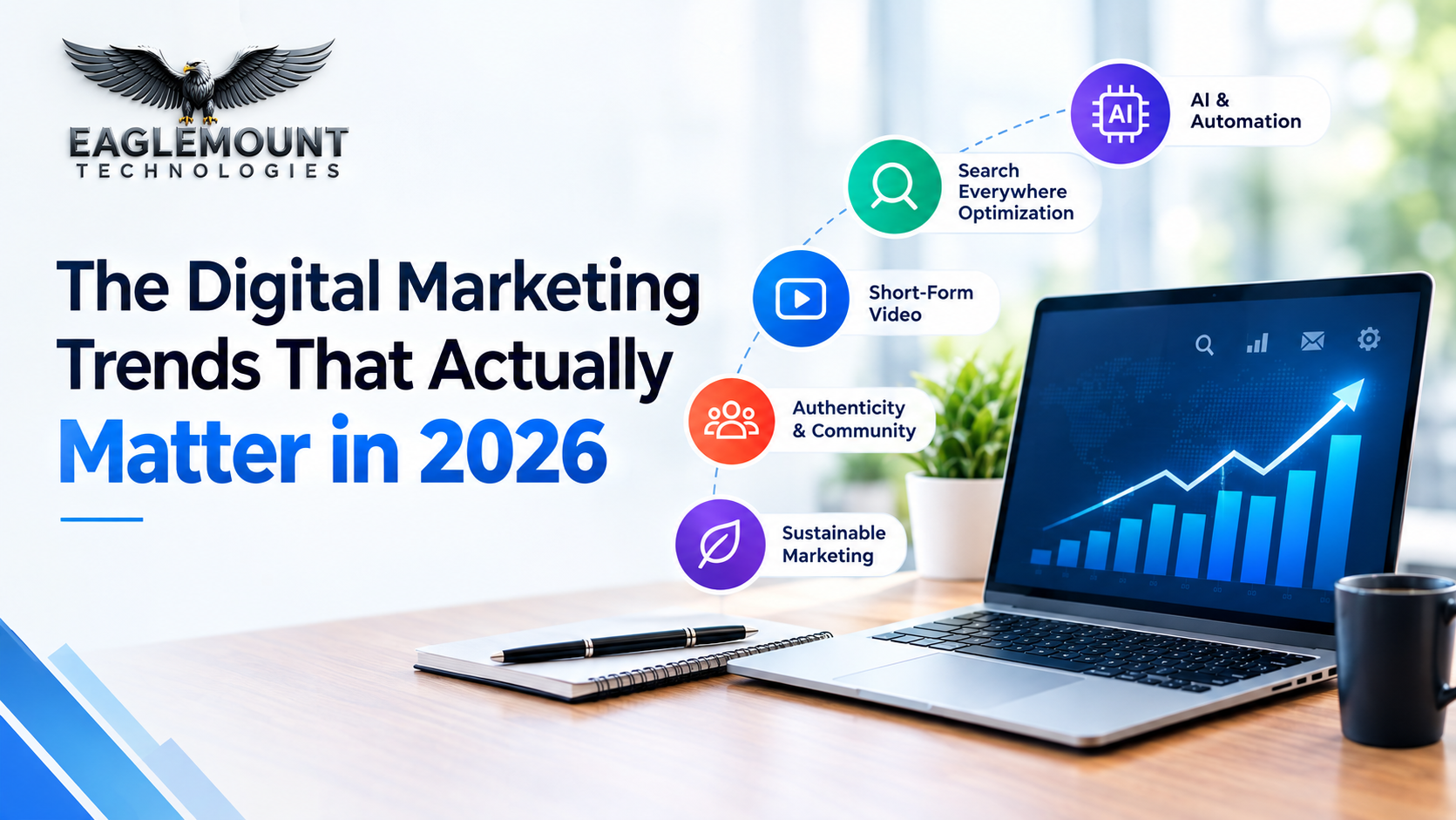
The Digital Marketing Trends That Actually Matter in 2026
Ask me a year ago what the biggest digital marketing trends of 2026 would be, and I'd have said more AI, obviously, shrugged, and moved on. That answer was right, technically. It was also useless. AI is everywhere now, sure. But the real story this year isn't the AI itself — it's what it's quietly done to the plumbing underneath. How people search. Where they click, or more often, don't. What "visibility" even means when half your audience never lands on your site at all.
I run SEO and content for a handful of Australian clients across e-commerce, SaaS, and local services, so I don't have the luxury of theorizing about this stuff from a distance. I'm in the reports every week watching what actually moves — and this year that's stretched well past SEO into how AI is reshaping paid media, social, and even who is actually reading what you're putting out. Some of the patterns keep showing up. Some of the things I'm looking at, and those are the ones worth talking about here. Not the buzzwords everyone's throwing around at conferences. The stuff that's genuinely changed how the work gets done.
Google isn't sending traffic the way it used to, and that's the whole story right now
Why zero-click search changes the whole game
This is the thing keeping most SEOs up at night, mine included. AI Overviews show up on a huge chunk of informational searches now, and when they do, click-through rates take a real hit. Depending which report you read, somewhere around half of all Google searches end without a single click. People get their answer right there on the results page. They never come to your site.
Here's the part that's hard to sit with: you can rank #1, do everything right by the old playbook, and still watch your traffic flatten because an AI summary answered the question before anyone scrolled far enough to see your listing. Ranking used to guarantee traffic. It doesn't anymore. Those two things have come apart, and a lot of clients are still catching up to that.
What actually works now: the basics of GEO
So what actually works? Treating visibility as something bigger than the blue links. That means showing up inside AI Overviews, and inside ChatGPT, Perplexity, and Gemini answers too — not just Google's results page. Some people call this Generative Engine Optimization, or GEO. I'm honestly not fussed about the label, could call it anything. What actually matters is a lot more boring than the acronym suggests. Get to the point fast — the first couple of sentences, not buried three paragraphs in. Write content that still holds together if someone rips a chunk out of it and drops it into a chatbot answer, because that's basically what's happening now.
Fill in your schema properly instead of pasting the same block in once back in 2022 and forgetting about it. And put a real person's name behind the work, someone with an actual track record, because a model needs a reason to trust the byline before it'll cite you. E-E-A-T stopped being a compliance checkbox a while back. It's the actual filter now.
Here's the bit nobody mentions enough, though - the traffic that does slip through from AI answers tends to convert better than average.
You get fewer visits, but the people who show up are further along in deciding, and they already half-trust you because an AI system just vouched for you. If you're only counting sessions in your monthly report, you'll think you're losing ground when you might actually be winning a smaller, hotter slice of the market.
A quick action list, not just theory
A few things worth actually doing here, not just nodding along to. Answer the core question in the first two or three sentences of a section before going deeper. AI systems tend to grab the part that reads like a direct answer, not the three paragraphs of throat-clearing before it. Get FAQ, How To, Article, and Organization schema properly filled in; it's one of the clearest signals you can hand an AI crawler about what your page actually is.
Put a real name and bio behind your content, with a LinkedIn profile and a body of work that backs up the claim of expertise — anonymous "admin" posts are becoming a liability, not just wasted potential. Start tracking where you're cited inside AI answers for queries that matter to you, the same way you'd track a keyword ranking. And stop treating Google as the entire game. ChatGPT and Perplexity in particular are turning into genuinely channels for research-heavy, comparison-style searches, and if your content strategy only accounts for Google, you're optimizing for maybe half the map.
AI went from a tool marketers used to something closer to a teammate
What humans are actually needed for now
Every marketing team I talk to is using AI for something by now — drafting, generating ad variations, crunching analytics, personalizing at scale. That part stopped being newsworthy a while back. What's shifted is what humans are actually needed for once the AI is doing all that.
Nobody's getting paid to bang out a first draft anymore. They're getting paid to know whether that draft is any good, to catch it when the AI's targeting logic is quietly wrong in a way that'll cost money, and to make the calls a model simply can't make on its own. Agentic AI systems that go beyond suggesting and actually execute campaign steps themselves are starting to run real customer engagements task by task. The marketers who'll still matter in a year or two are the ones learning to supervise these systems, not the ones trying to out-type them.
Practically, that means less time on execution grunt work and more time on strategy, on brand judgment, on knowing your audience well enough to feel it when the machine's output is slightly off — even if you can't immediately say why.
The sameness problem nobody's fixing
There's a quieter problem sitting inside all this that doesn't get talked about enough. AI-generated content is starting to sound the same everywhere. Same sentence rhythms. Same tidy three-point structures. Same openings about how the world is changing fast. Audiences are getting sharper at spotting it, and honestly, so are the AI detection tools now run their own content through. The teams pulling ahead are the ones roughing up the polish on purpose — a real opinion with some edge to it, a sentence that doesn't quite match the one before it, an anecdote that couldn't have come from a training set. Funny how that works. The more AI writes for everyone else, the more an actual human voice becomes worth something.
Flat budgets are forcing a martech clean-out, and honestly it's overdue
Marketing budgets haven't grown much this year relative to revenue, and a lot of businesses are sitting on tool stacks that outgrew what their teams could realistically use. The response has been consolidation — fewer platforms, more weight on tools that do several jobs reasonably well instead of ten tools each doing one thing.
If you're running a lean team, or juggling five client accounts the way I am some weeks, this is good news more than bad. It's pushing agencies toward platforms that combine SEO, content, and reporting in one place, instead of a graveyard of subscriptions nobody remembers signing up for.
Short-form video stopped being optional a while ago
TikTok, Reels, YouTube Shorts. This one is less "new trend" and more "finally too big to ignore." A large share of marketers now lean on AI just to keep pace with how much short-form video content these platforms expect. It's not really about chasing virality anymore — it's about showing up consistently enough that the content feels native, not like an ad someone paid to interrupt a scroll.
The brands doing this well usually aren't the ones with the biggest production budgets, in my experience. They're the ones willing to look a bit rough around the edges — someone talking to camera, not a script being read off a teleprompter.
Personalization is getting sharper while privacy rules tighten around it
Consumers keep telling researchers they'll buy more from brands that personalize well, and that pressure isn't easing off. But the old approach — hovering up third-party data and following people around the internet with retargeted ads — is on its way out, thanks to privacy rules and third-party cookies finally dying the slow death everyone's predicted for years.
The brands handling this well are leaning into first-party data instead: email lists, on-site behavior, actual direct relationships with customers. They're pairing that with predictive analytics to spot demand shifts before competitors even notice them moving. It's a slower, harder way to build a data strategy. It's also a lot more durable, because nobody can regulate away data you collected with someone's actual consent.
Local search is getting quietly more personal too
There's a smaller trend running underneath all the AI-search noise that I think deserves more attention than it gets. Local search is being reshaped by the same engines changing everything else. Ask an AI assistant to find a plumber near me these days, and it's not spitting back a generic directory list — it's weighing location, review quality, business hours, and sometimes even the context of your past questions to hand you something closer to an actual recommendation.
For local and service businesses, that raises the bar on stuff that's boring to talk about but genuinely essential — an accurate Google Business Profile, consistent name-address-phone details across every directory you're listed on, a decent volume of real reviews, and local business schema that's actually filled in. It's not as exciting as talking about GEO at a conference. It's often where the real revenue for smaller businesses actually sits.
AI agents are starting to do the shopping, not just suggest it
Last year the question was mostly "which AI tool do we actually need." This year it's shifted to something bigger — how do you use AI at scale without it just becoming noise. A big part of that shift is AI agents. Not chatbots bolted onto a website as an afterthought, but systems that actually make decisions and take actions on their own, without someone standing over them approving every step.
Picture an AI assistant that troubleshoots a product issue, reschedules a delivery, or manages a subscription end to end, no human in the loop unless something goes wrong. Some businesses are already testing this on the customer-service side.
There's a stranger version of this coming too, the kind that sounds a bit sci-fi until you actually see it running. An AI agent doing the shopping itself — searching, comparing, adding to a cart, and just asking a human to approve the final purchase. For anyone in e-commerce, that changes more than the checkout flow. It changes who — or what — you're actually writing product pages for.
A distinct brand voice is turning into an actual ranking signal
Zero-click search means fewer people click through to see who's behind an answer, so the burden shifts onto making your brand recognizable even when nobody's landing on your page. A flat, generic tone doesn't help with that. If your content reads like everyone else's in the category, search engines and AI systems alike have less reason to pick you out of the pile.
The brands doing this well tend to have a voice you could recognize with the byline covered up. It doesn't have to be jokes or personality-forward copy — plenty of B2B brands do it through a consistent point of view or a way of framing things nobody else quite does. The point is distinctiveness, not entertainment.
The AI content glut is starting to work against the brands using it carelessly
There's a phrase going around now for the flood of low-effort AI content clogging up feeds — people are calling it "AI slop," and it made it into the dictionary this past year, which tells you something about how visible the problem's gotten.
A lot of it is AI-generated video and images, and the frustrating part is that this stuff often performs well in the short term because it's engineered to be watchable, even when it's shallow or flat-out wrong.
That's actually an opening, not just a warning. Search engines are leaning harder toward rewarding original, people-first content, which means genuinely human work has room to stand out precisely because so much of the internet is starting to sound the same.
Paid media is leaning further into automation, but creative still separates winners
On the paid side, AI is taking over more of the mechanical work — audience targeting, placement decisions, budget shifts happen largely on autopilot now across most major ad platforms. Google and Meta are expanding and adjusting campaigns automatically based on intent signals rather than rigid keyword lists.
The catch is that automation flattens most of the levers marketers used to pull by hand. When targeting and bidding are mostly out of your control, creative becomes one of the few things left that actually differentiates a campaign. Teams getting real lift out of AI-assisted advertising tend to feed it a wide range of creative variations to test rather than treating the automation as a set-and-forget switch.
Social media is splitting into communities and getting a bit more real
Overall social media usage keeps climbing, but how people use it is shifting under that growth. Community-focused platforms and spaces — think Reddit-style forums, Discord servers, paid newsletter communities — are pulling attention away from the broadcast-to-everyone model that defined social media for the last decade. People seem to want smaller, more genuine conversations over chasing viral reach.
At the same time, there's a pushback against overly polished, corporate-feeling content. Founder-led brands sharing real behind-the-scenes moments, employees posting in their own voice instead of official company accounts, and a general appetite for content that doesn't feel scripted are all gaining attention.
Where all this leaves us
None of this means the fundamentals of good marketing changed. People still buy from brands they trust. Content that genuinely answers a question still wins out over content that's just optimized to rank. Shortcuts still get found out, eventually, one way or another.
What's changed is the terrain underneath all of that — search fragmenting across half a dozen AI engines, attention fragmenting across short video platforms, and the tools sitting between you and your audience getting more automated by the month.
If there's one thing worth taking from where 2026 has landed so far, it's this. The brands doing best right now aren't the ones chasing every new AI feature the moment it launches. They're the ones who got the fundamentals solid enough — genuine expertise, real first-party relationships, content built for an actual human reader first — that they show up well no matter which engine, platform, or algorithm happens to be doing the sorting this particular quarter.
Not sure where your own brand actually stands in all this?
Honestly, most of my clients don't know the answer to this until someone sits down and checks. Are you showing up inside AI Overviews for the searches that matter to you? Is your content even structured in a way an AI system would want to lift and quote? Is your local listing pulling any weight, or just sitting there half-finished?
You can guess, or you can get someone to actually dig into the data. That's the audit and strategy work the team over at Eaglemount Technologies does, day in and day out. If any of this has you second-guessing whether your marketing still fits how people search now, it is worth having a proper look under the hood.
FAQs
Is SEO still worth the money if zero-click search keeps eating traffic?
Yes. The definition of "winning" moved, that's all. SEO didn't stop working just because fewer people click through. Good rankings and clean structure are now also your ticket into AI Overviews and chatbot answers, and a lot of discovery is quietly happening there now instead of on the results page.
Okay, but what actually separates SEO from GEO?
SEO gets you ranked on a results page. GEO gets you quoted inside an AI-generated answer. Different goal, similar toolkit really — clarity, structure, real authority behind the content. Most of what makes something rank well is also what makes an AI model trust it enough to cite.
Is 2026 the year AI actually takes marketers' jobs?
Doubt it, at least not the way the question implies. What's happening is more of a reshuffle. AI is handling drafts, testing ad variations, chewing through analytics and the mechanical work that used to eat a whole afternoon. What's not great at, still, is knowing whether a brand voice feels right, or whether a strategy actually fits an audience versus just looking clean in a slide deck. That judgment call is still very much a person's job.
Do B2B or service brands even need short-form video?
More than most think, yeah. People research a service on video before they ever pick up a phone. It doesn't need to be polished. It just needs to exist and show up regularly.
Tight budget - what's actually worth spending on first?
Boring stuff, mostly. Get the Google Business Profile right. Fix technical SEO issues that have probably been sitting there for months. Start an email list if you don't have one already. Write content that's genuinely useful instead of padded out to hit a word count. None of that's flashy, but it's the stuff that keeps paying off regardless of what the algorithms do next month.
Are AI agents actually going to change how people shop, or is that overhyped?
Somewhere in between, honestly. The customer-service side — an agent handling a return or rescheduling a delivery on its own — is already real and working. The idea of an agent doing the actual shopping, comparing and adding items to a cart on someone's behalf, is earlier stage but moving faster than most people expect.
Does paid advertising still need much human input if AI Max and similar tools handle targeting?
Yes, just in a different place. Automation has taken over most of the targeting and bidding mechanics, which means creative is now one of the only levers left that actually differentiates a campaign. Feeding the automation a wide range of variations to test tends to matter more than fiddling with settings manually ever did.