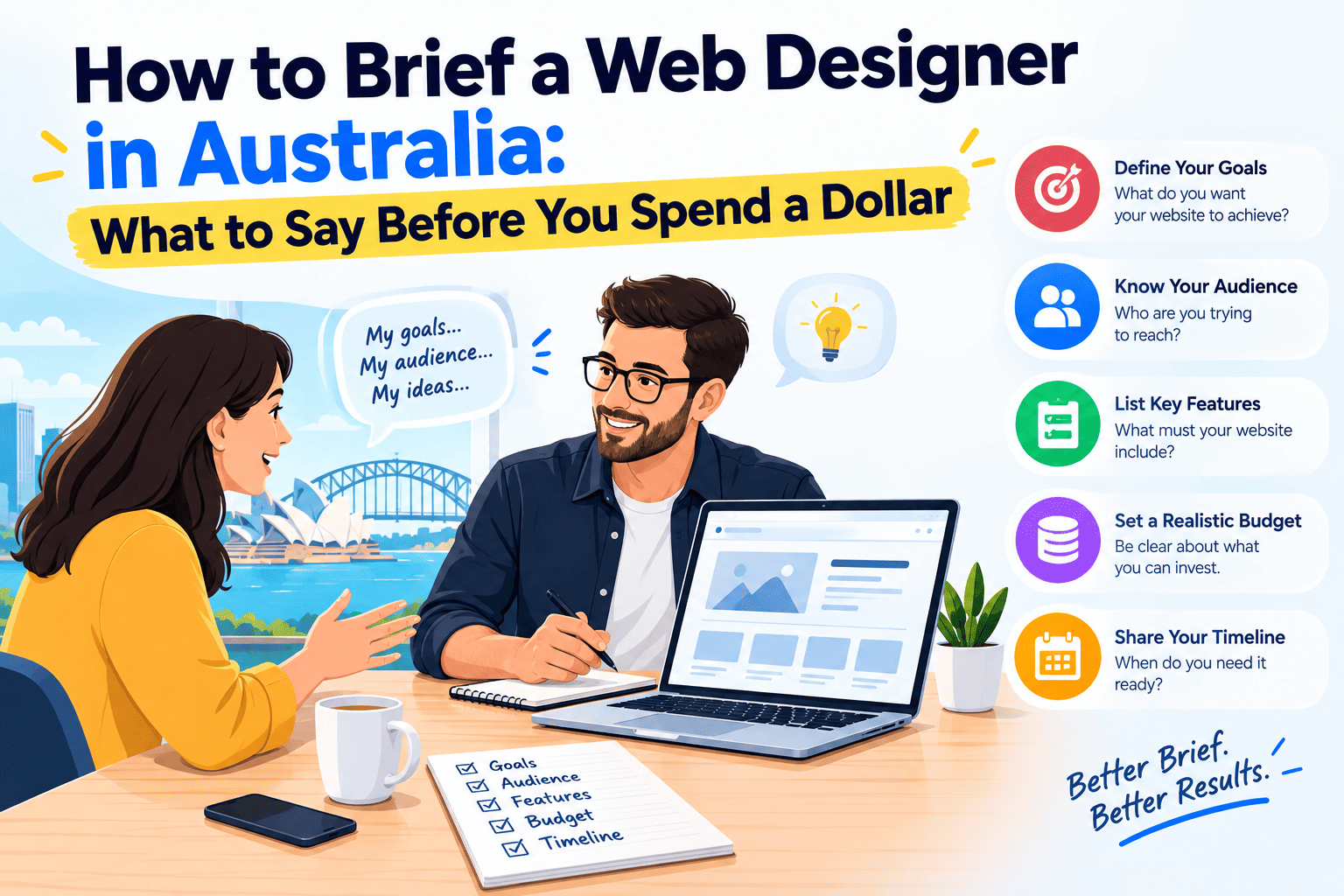
How to Brief a Web Designer in Australia: What to Say Before You Spend a Dollar
A Geelong plumber pays a designer good money, asks for something that looks professional, and three weeks later gets a gorgeous site where the phone number hides in a mobile menu, half the suburbs he services aren't mentioned and the homepage photo chugs on anything short of wi-fi. She hadn't stuffed up, though. His brief ran to one sentence, and she built exactly that.
We see versions of this all the time, and it nearly always traces back to the conversation that happened before any design did. So what follows is how we'd brief a professional web designer here in Australia, plus what's worth getting down in writing before a dollar changes hands.
Why the brief matters more than the design
Most of the trouble starts in that very first conversation, if we're being straight about it. A designer who hasn't heard who you're trying to reach, or what you'd like a stranger to do once they arrive, will fill in the gaps with their own assumptions, which is usually how people end up three revision rounds deep, past the launch date they'd promised the boss and swapping slightly terse emails. Having it all written down gives you something to fall back on, say when the first draft arrives looking nothing like the picture in your head and nobody can quite agree on what got said in that Zoom call back in March.
Start with the goal, not the look
Colours and fonts are what everybody wants to talk about first, and we get it, they're the fun part, but we'd park them for a minute and ask what the site actually has to do. Get the phone ringing? Sell stuff? Fill the diary with bookings? Maybe it's only there so people believe you're a proper business before they hand over a deposit. Whichever it is, choose one main job and perhaps a smaller one on the side, because a site asked to juggle ten things tends to drop most of them. A rough target helps as well, even if it's a total guess (ten extra enquiries a month, say). "We want to grow online" tells a designer almost nothing.
Tell them who it's for
Try describing your customer the way you would to somebody starting on Monday: how old they're likely to be, which suburb or town they're in, what's bugging them by the time they land on your page, and whether they're on their phone on the couch at 9pm or at a desk on a Tuesday afternoon. A yoga studio in Brunswick and a farm machinery dealer near Wagga should feel nothing alike, and the designer only gets there if you've said so.
Web Design Melbourne Small Business: What to Put in Writing
For a web design Melbourne small business project, or really anywhere in Australia, here's what we'd put in the brief:
- What you do, who for, and which suburbs or regions you cover
- The main goal, and any secondary ones
- Pages you reckon you'll need (a rough list is fine)
- Whatever you've already got: logo, photos, testimonials, old service descriptions
- Two or three sites you like and one you can't stand, with a line on why
- Must-have features, like online booking, a shop or a quote form
- Who's writing the copy and who's sorting the photos, because this gets forgotten constantly
- Your deadline and what's driving it (a trade show, EOFY, a new hire?)
- A budget range, or at least a ceiling
The budget one makes people squirm, but sharing a range usually saves time all round. A decent designer can tell you in about two minutes what's realistic at that level and what should wait for phase two.
How to choose a web designer
Type "website designer near me" into Google and you'll get a wall of options. Local's nice if you like meeting over a coffee, but it's not the be-all. When we think about how to choose a web designer, these are the things we'd check.
Their past work. Forget the homepage for a sec and pull their portfolio up on your phone while you're standing in a queue somewhere. If it takes ages to load, or you can't find the contact button, you've learned plenty.
Whether they've done something like yours. A designer who's built twenty restaurant sites might not be the best fit for a B2B services firm, and vice versa.
Who does the work. Some agencies send a senior person to the pitch and then hand the build to someone junior, or to a team overseas. Not necessarily bad, but you're entitled to know.
How they talk about SEO. If a designer says search is "something we can do later", that's worth a raised eyebrow, because bolting it on after the build is usually messier and more expensive. You can read more about how that side works in our guide to SEO services in Australia.
What happens after launch. Ask who looks after hosting, updates and the odd broken contact form at 4pm on a Friday.
Website design cost in Australia: talking about money properly
Everyone wants a straight number for website design cost in Australia, but the answer really does swing about. A basic brochure site from a small studio might come in somewhere around the low thousands, a custom job with a shop, bookings or other integrations can climb well into five figures, and the big agencies charge more again. Take those as loose ballparks, since what's actually in the scope matters a lot more than what the proposal is called.
What catches people out is usually stuff that never made it into the headline price, so it's worth asking about:
- Hosting, domain renewals and SSL certificates
- Who pays for stock photos, plugins or paid themes
- How many rounds of revisions are included
- Content writing, if you're not doing it yourself
- Ongoing maintenance, and what that actually covers
- Who ends up owning the site and its files when it's finished, and whether that's in writing
Ask two or three studios for written quotes and read what each one includes before you even look at the totals. Often the cheapest is only cheap because it quietly leaves out things the others have priced in.
Custom or template?
Neither's wrong. A template site is a sensible choice if you're just starting out and need something decent without a big spend, and custom website design in Australia earns its price when you've got unusual requirements, a crowded market or a brand that has to stand out. Good designers will say which they'd go with and why. If they push the pricey option every single time, well, that tells you something.
Redesigning an existing site
If you've already got a site, a website redesign in Australia needs a bit more care than people expect. A shiny new version can quietly wipe out years of search visibility if the old pages aren't handled properly. Tell the designer which pages bring in traffic and enquiries right now, and ask how they'll deal with redirects and page titles. It's a boring conversation that can save you a nasty dip in leads a month after launch.
Red flags worth noticing
- A quote that shows up without a single question about your business
- Fuzzy answers about who owns the site or the domain
- Pressure to sign today because of a "special price"
- No live examples you can actually visit
- A promise of first-page Google rankings by the end of the month
Pulling it together
A good brief doesn't have to be long or clever. Two pages covering your goal, your customers, your content, your must-haves and your budget will put you ahead of most people walking into a first meeting, and the designer's life gets easier too, which tends to show in the result.
If you're weighing up a web design agency in Australia and want a straight conversation about what your project would involve, get in touch with the team at Eaglemount Technologies. You can also have a look at our website development services to see how we approach it. No pressure, and no jargon either.