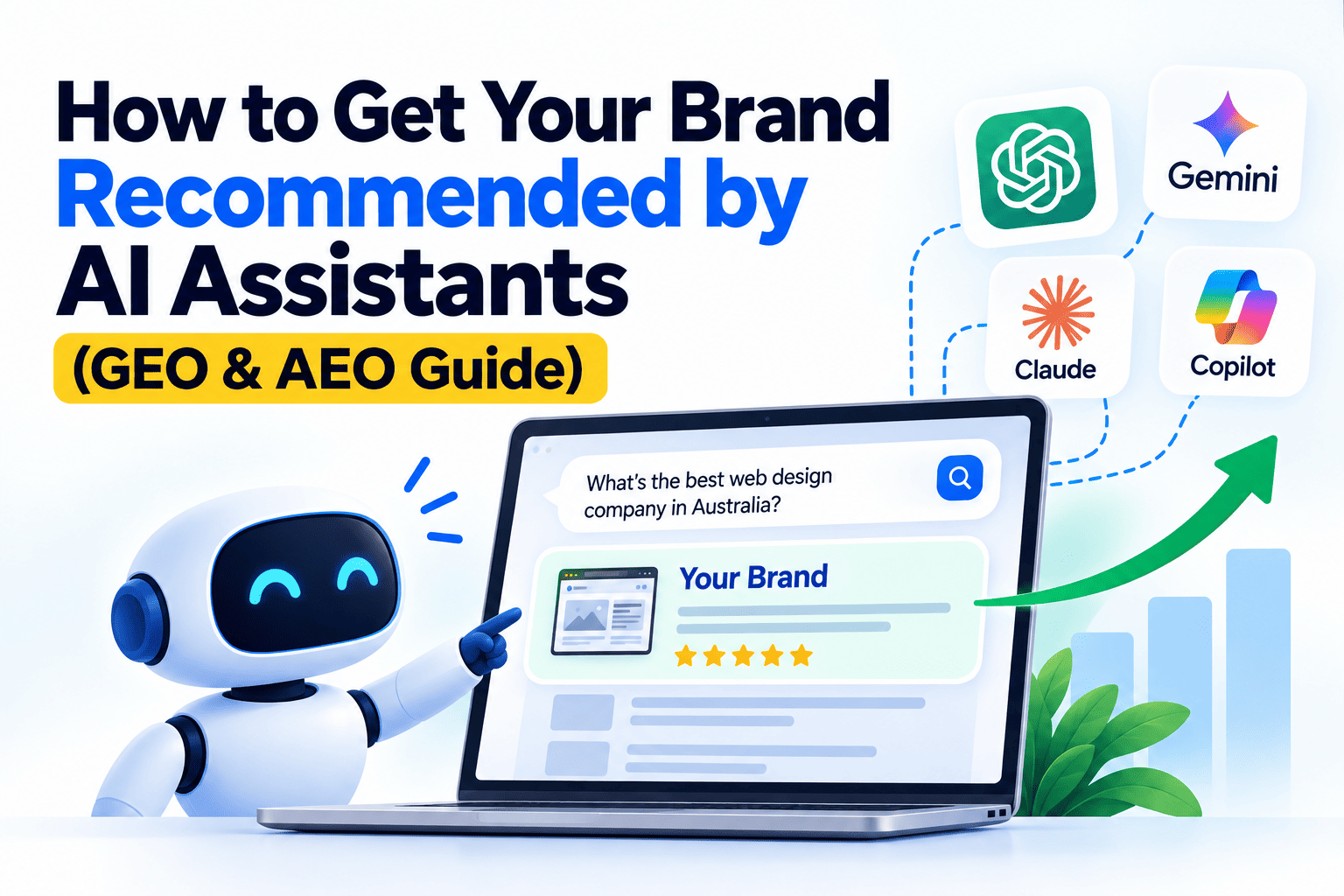
How to Get Your Brand Recommended by AI Assistants
A few months ago, a client of ours sent a screenshot. He’d asked ChatGPT for “a good web agency in Melbourne” and wanted to know why his name wasn’t on the list. He’s been ranking on page one of Google for years, so it stung.
That’s the shift in a nutshell. People still search on Google, but a growing number now just ask an AI and trust whatever comes back. If your brand isn’t in that answer, the customer may never even see your website.
The practice of fixing that is called generative engine optimization (GEO), and you’ll also hear answer engine optimization (AEO) used for much the same thing. Here’s how it works in plain language.
GEO vs SEO: what’s actually different?
SEO is about ranking a page so people click it. GEO is about being the source an AI pulls from when it writes an answer. The goal moves from “get the click” to “get the mention.”
SEO isn’t dead, though. Most AI tools lean on the open web to find information, so strong, crawlable content still matters. GEO builds on good SEO. It doesn’t replace it.
How AI assistants decide who to recommend
Nobody outside these companies knows the exact formula, so be wary of anyone who claims they do. But a few patterns keep showing up:
- They favour brands that are mentioned in many places, not just on their own site.
- They prefer content that answers a question clearly and early.
- They trust sources that look credible: real authors, real reviews, consistent business details.
Think of it like word of mouth. An AI recommends who it has “heard” good things about.
7 practical ways to get recommended
1. Answer questions the way people ask them.
Write headings as real questions: “How much does a mobile app cost in Australia?” Then answer in the first two sentences, and add detail after. Short, direct answers are easier for an AI to lift and quote.
2. Be specific about who you serve.
“We help everyone grow online” gives an AI nothing to work with. “We build e-commerce websites for kitchen and cabinet businesses in Australia and New Zealand” does. Specific beats broad.
3. Use structured data.
Schema markup (Organization, LocalBusiness, FAQ, Article, Review) tells machines exactly what your page is about. It won’t guarantee a mention, but it removes guesswork, and that’s rarely a bad thing.
4. Build your presence outside your own website.
This is the one most businesses skip. Get listed and talked about on Google Business Profile, LinkedIn, industry directories, review sites, and relevant publications. Mentions on trusted third-party sites carry real weight.
5. Keep your business details identical everywhere.
Same name, same address, same phone, same service descriptions. Mixed-up details make you look unreliable to people and to machines.
6. Show real expertise.
Add author names and short bios. Share case studies with actual results. Publish things only someone who does the work would know. Generic content is everywhere, and AI has plenty of it to ignore.
7. Make your site easy to read for bots.
Check you aren’t blocking AI crawlers by accident in your robots.txt. Keep pages fast, clean and mobile friendly. Some teams are also adding an llms.txt file as a plain-language summary of the site. It’s still early days and nobody can promise it moves the needle, but it’s cheap to try.
What is llms.txt, and should you bother?
You’ve probably heard of robots.txt, the file that tells search bots where they can’t go. llms.txt is a bit like its friendly cousin. It’s a plain text file that sits at the root of your site (yourdomain.com/llms.txt) and gives AI tools a short summary of who you are and which pages matter most.
Think of it as a cheat sheet. Instead of an AI wading through your whole site, you hand it the highlights.
The idea was proposed in 2024 and it’s still not an official standard. None of the big AI companies have clearly said they use it when deciding who to recommend. So no, it’s not a magic switch. But it takes about twenty minutes to set up and costs nothing, which is why we add it for clients anyway.
What goes in it
- Your brand name as a heading
- One or two lines on what you do and who you serve
- Links to your key pages, each with a short plain description
Here’s a simple example:
# Eaglemount Technologies

> Melbourne-based digital agency offering website development,
> mobile app development, SEO and digital marketing for clients
> across Australia, Asia, Europe, North America, the UK and Dubai.

## Services
- [Website Development](https://eaglemounttechnologies.com/services/website-development/): Custom, fast, scalable websites
- [SEO Packages](https://eaglemounttechnologies.com/services/seo-packages/): SEO plans built around your markets

## Company
- [About Us](https://eaglemounttechnologies.com/about-us/): Who we are and how we work
- [Blog](https://eaglemounttechnologies.com/blogs/): Guides on SEO, GEO and digital marketing
A few tips. Keep it short. Link only the pages you’d actually want an AI to read, not your entire sitemap. Write descriptions like you’d explain them to a person, no buzzwords. And update the file when you add or remove important pages.
Does it work the same in every country?
Not quite. What AI recommends for “digital agency” in Sydney won’t match London, Dubai or Toronto. Language, local directories, regulations and even preferred platforms change from market to market.
If you sell in more than one region, build local proof for each: local reviews, local case studies, local pages. A UK client wants to see UK results. A Dubai buyer may search in Arabic and English. One global page rarely cuts it.
How to know if it’s working
Tracking GEO is messier than tracking rankings. A simple routine helps:
- Pick 10 to 15 questions your customers really ask.
- Run them through ChatGPT, Gemini, Perplexity and Google’s AI Overviews every month.
- Note whether your brand appears, what’s said about you, and who shows up instead.
- Also watch branded search and direct traffic in GA4. If people start finding you by name, something’s working.
Results vary between runs, so look at trends over a few months, not single answers.
Common mistakes to avoid
- Stuffing pages with “GEO” buzzwords instead of useful answers
- Publishing a mountain of thin, generic articles
- Ignoring reviews and third-party mentions
- Expecting results in two weeks. This is slow, steady work.
Final thoughts
AI assistants are becoming the new first stop for buyers. The brands that get named are the ones that are clear about what they do, visible across the web, and genuinely helpful.
At Eaglemount Technologies, we’re a Melbourne-based digital agency working with businesses across Australia, Asia, Europe, North America, the UK and Dubai. If you’d like to know whether AI tools are recommending you, or your competitors, get in touch for a free consultation and we’ll take a look.